HISAT2 Tutorial: RNA-Seq Read Mapping & Splice-Aware Alignment
📖 RNA-Seq Data Analysis Workflow — check it out for an overview.
Introduction
Quantifying gene expression from RNA-Seq sequencing data typically requires a mapping step. Mapping is the process of aligning read sequences (FASTQ files) to their corresponding positions on a reference sequence. Popular mapping tools for RNA-Seq include HISAT2, STAR, and Bowtie2. This page walks through how to use HISAT2.
For an overview of the entire RNA-Seq data analysis workflow, see the RNA-Seq analysis workflow guide.
Installation
Precompiled binaries are available from the official download page. Download the version that matches your operating system.
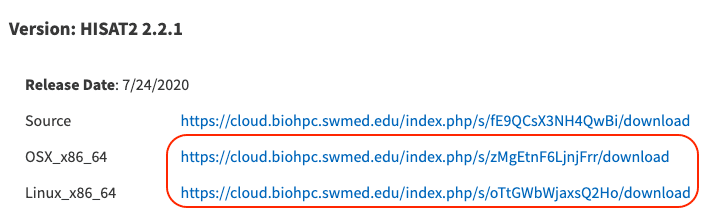
Extract the archive and make sure the binary is on your PATH (the example below is for macOS).
Verify the installation by displaying the help message:
If you see output similar to the following, HISAT2 has been installed successfully.
Index construction (build)
Before mapping, you need to build an index from the reference sequence with the following command:
Here, genome.fa is the FASTA file of the reference genome you want to align reads against.
This produces eight files named genome.1.ht2 through genome.8.ht2. Index files enable fast sequence lookup and must be generated ahead of time for virtually all mapping tools, not just HISAT2.
Mapping
Now you can align the reads to the reference genome:
This produces a SAM file containing the alignment results. In practice, it is convenient to convert the SAM file to BAM format and sort it for downstream analysis:
You can inspect the results in a genome browser such as IGV. The aligned reads will appear as shown below.

RNA-Seq Data Analysis Software
This is an RNA-Seq Data Analysis Software recommended for those who:
✔︎ Seeking to avoid outsourcing or collaboration for RNA-Seq data analysis.
✔︎ Lacking time to learn RNA-Seq data analysis.
✔︎ Frustrated by the complexity of existing tools.
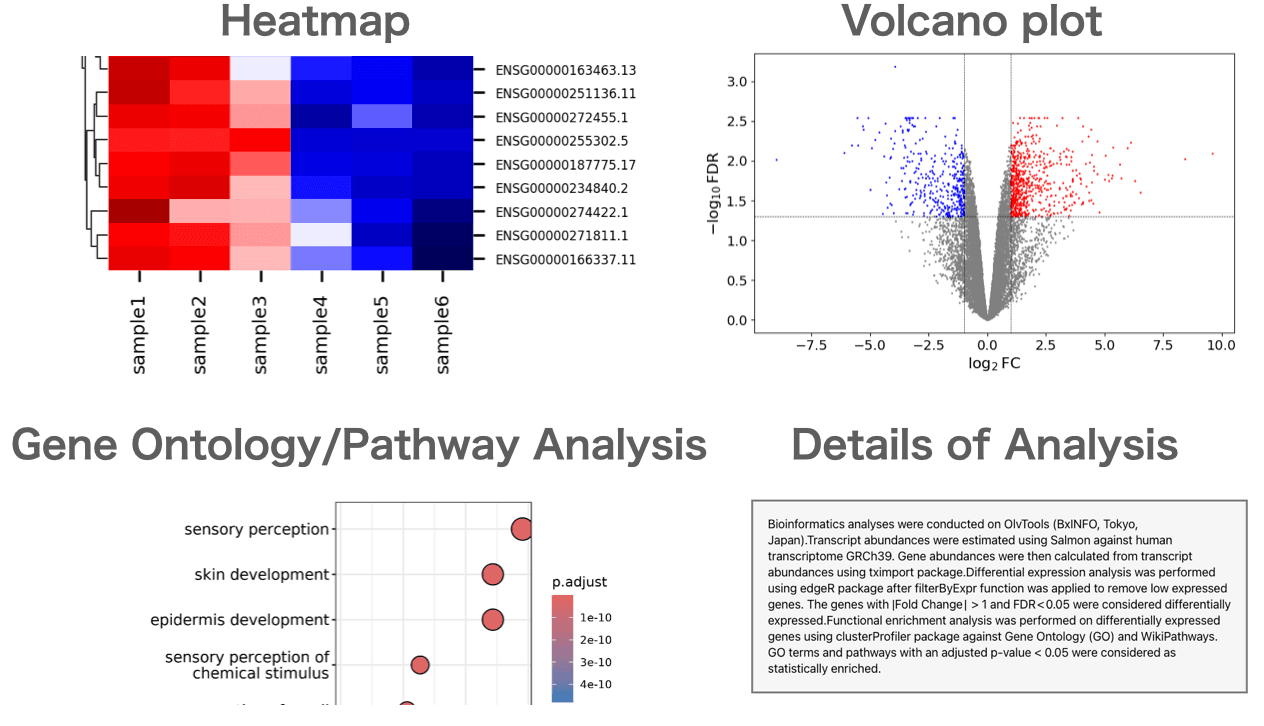
Users can perform gene expression quantification, identification of differentially expressed genes, gene ontology(GO) analysis, pathway analysis, as well as drawing volcano plots, MA plots, and heatmaps.
About the Author


BxINFO LLC
A research support company specializing in bioinformatics.
We provide tools and information to support life science research, with a focus on RNA-Seq analysis.